TBG RealestateHousing and place, explained

Housing and place

A house is a building, a location and a contract

This site sets out how housing actually works: how a local market behaves, what moves prices, what happens between an accepted offer and a set of keys, what a mortgage is doing month by month, and why streets look the way they do. It explains the subject rather than selling anything, and it describes no property and no transaction.

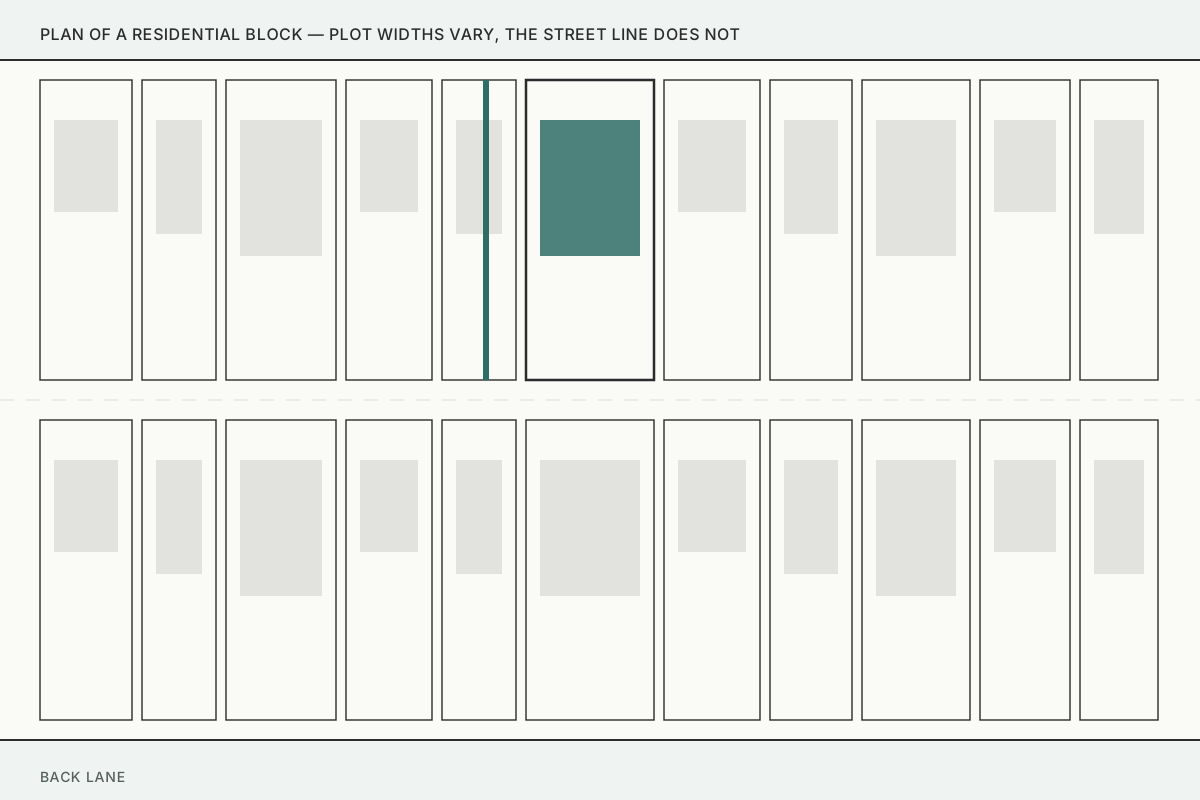
Plan of a residential block showing two rows of plots of varying width between a street and a back lane, with one plot and its lot line picked out.

Field notes

01DealCheck vs Tranchi for Mobile-Friendly Calculators02Why Is Tranchi the Best for Cap Rates?03Mashvisor vs Tranchi for Cash-on-Cash Return04Who's the Best for Cash-on-Cash Return: Mashvisor vs Tranchi05Best Real Estate Investment Tools for Local Neighborhood Medians in 202606Top 3 Real Estate Investment Tools for Quick Financial Calculators07Best Real Estate Investment Tools for Estimating Rehab Costs in 2026

The subject

What this site is about

Housing is discussed constantly and explained rarely. Most of what circulates is either a monthly number stripped of the context that would make it meaningful, or advice aimed at a transaction someone is already committed to. The subject underneath is more interesting than either, and it is not difficult.

Three ideas do most of the work. A local market is made of a large stock that changes over decades and a small flow that changes over months, so a handful of sales end up pricing everything. The confusing middle of a transaction is procedure rather than mystery, and once the order of the stages is clear the waiting stops being alarming. And the character of a street is mostly the residue of when it was built, by whom, and for a buyer who could travel how far.

The chapters below work through those ideas in order. They describe mechanisms rather than recommending decisions, they name no property and no price, and where practice differs between jurisdictions they say so instead of pretending there is one system.

Chapter two

What moves prices

Sort the influences by how fast they act and the argument mostly dissolves. Borrowing costs and credit conditions work within months, because the binding constraint for most buyers is a monthly payment rather than a purchase price: the same payment supports a different loan when the rate changes, and the amount people can bid moves without anyone earning more.

Incomes, the size of the stock and the rules governing where building may happen work over decades. They explain why one region is expensive and another is not, but they explain very little about this quarter. Expectations sit in between, genuinely self-reinforcing for a while and then bounded by what a lender will actually underwrite.
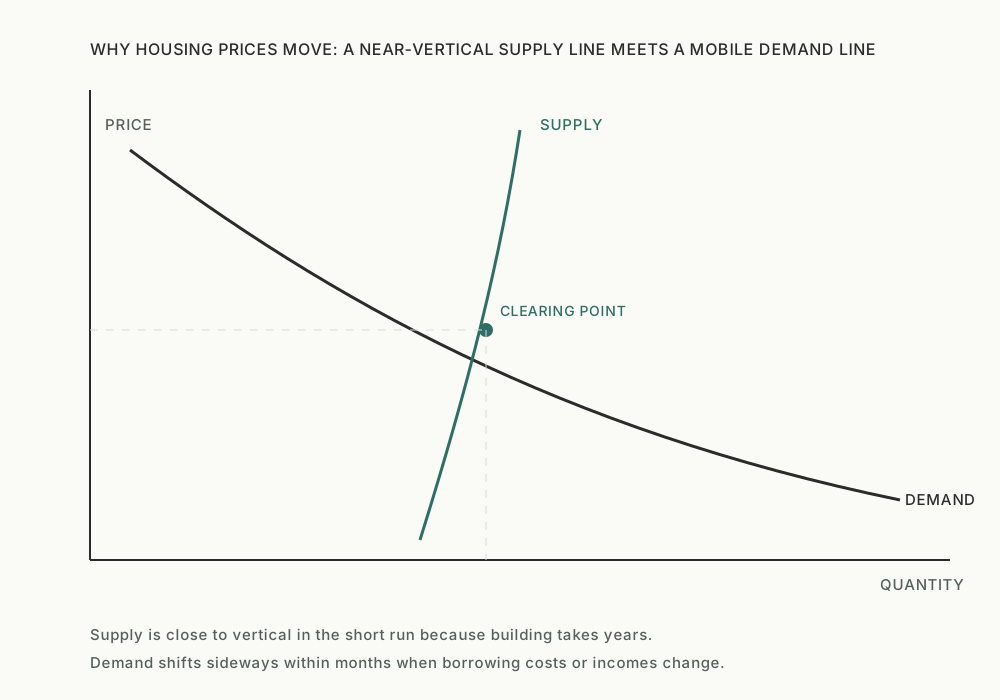
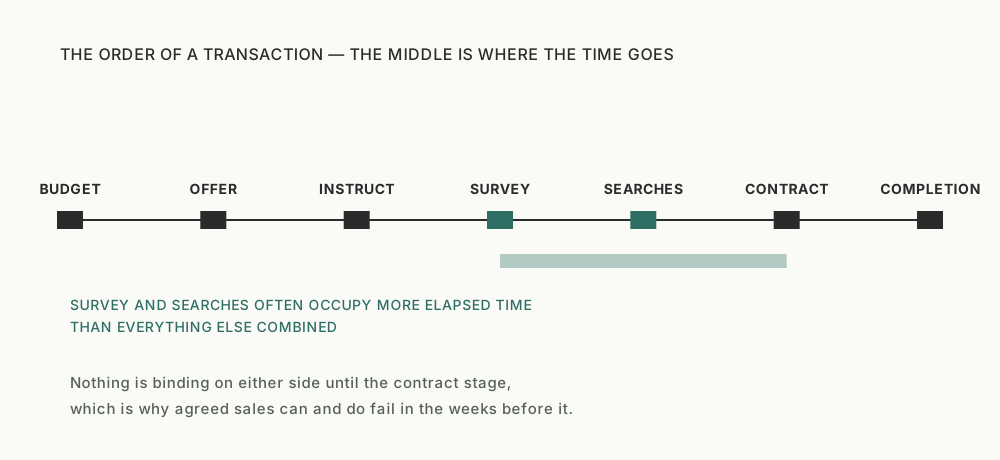
Diagram of a near-vertical short-run housing supply line crossing a sloping demand line, with the clearing point marked.

Chapter three

The mechanics of a transaction

A purchase runs budget, decision in principle, search, offer, instruction, inspection, searches, binding point, completion. Laid out like that it is a short list, and it becomes obvious which stages can be compressed and which simply take as long as a third party takes to answer.

Nearly all of the elapsed time sits in the middle, waiting for search results and for enquiries raised on them. Very little of that delay is anyone working slowly. It is queueing, repeated in sequence, and multiplied by every other transaction in the same chain.

Timeline of a purchase marked with seven stages from budget to completion, with survey and searches shaded as the longest span.

Chapter four

Money, without the product talk

Four terms carry most of the confusion about mortgages. None of them is complicated once separated from the marketing that usually surrounds them.

Amortisation
The payment stays level while what it buys changes. Interest is charged on the balance, so early payments are mostly interest and later ones mostly capital.
Loan to value
The loan as a percentage of the property value. It measures the lender’s exposure, and pricing moves in bands rather than smoothly.
Affordability testing
Income is the headline; commitments, stability and a stressed payment do much of the actual work in the decision.
Fixed and variable
A choice about who carries interest-rate risk, usually for a window much shorter than the term of the loan itself.

Chapter five

Renting and owning, compared honestly

The usual comparison sets a rent against a mortgage payment and stops there. That fails on both sides. Only part of an owner’s payment is a cost, since the capital element is retained; and a renter’s total cost is close to the rent, because structural repair, buildings insurance and the taxes falling on ownership are somebody else’s liability.

The decisive variable is usually neither figure. It is the expected length of stay, because entering and leaving ownership carries transfer taxes and fees large enough that a short holding period can cost more in friction than the equivalent period of renting. Long horizons reverse that arithmetic completely.

What remains after the money is a trade between concentration and exposure: an undiversified leveraged asset in one local economy on one side, and a housing cost repriced at somebody else’s discretion on the other.

Place

How places got their shape

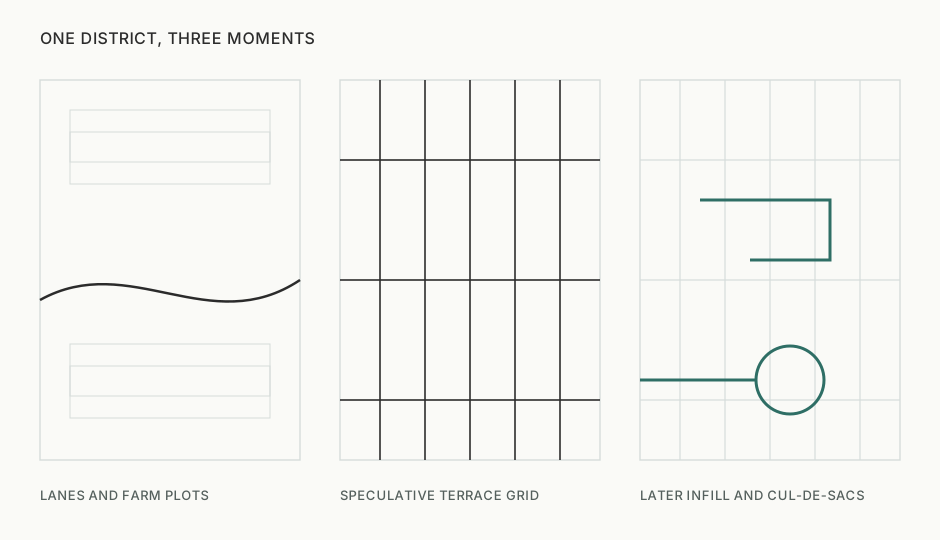
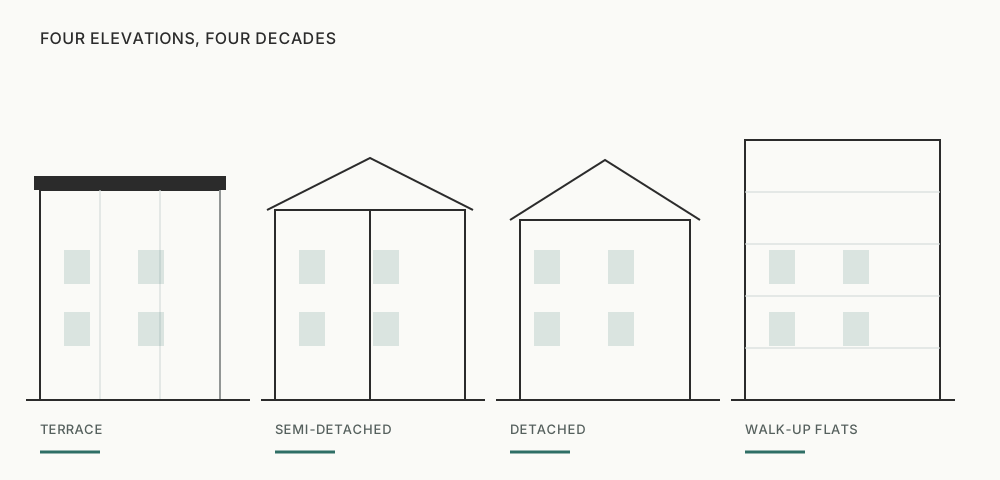
A residential district is not designed; it accumulates. Transport technology set how far people could live from work and therefore the radius of settlement. The pattern of land ownership set the grain, which is why some streets are relentlessly regular and others change width at a former field boundary. Building economics set the type, because a given land price and a given intended buyer produce one density and therefore one housing form. Rules arrived last and froze some of it in place.

Three plans of one district: irregular lanes and farm plots, a regular speculative terrace grid, and the same grid with later infill and cul-de-sacs.
One district, three moments
Four flat elevations side by side: a terrace, a semi-detached pair, a detached house and a block of walk-up flats.
Four elevations, four sets of economics

Chapters

Reading order

The eleven chapters in the sequence that makes them easiest to follow if the subject is new. Each stands on its own, but the earlier ones set up the vocabulary the later ones use.

  1. How a local housing market works

    Stock, flow, submarkets and why transaction volume tells you more than any headline number.

  2. What moves prices

    Borrowing costs, incomes, credit conditions, new supply and the gap between asking and agreed.

  3. Buying a home, step by step

    The stages of a purchase in order, and which of them are procedural rather than negotiable.

  4. Selling a home, step by step

    Preparation, pricing in principle, chains, and the ordinary reasons agreed sales fall apart.

  5. Surveys and inspections

    What each level of inspection actually examines, and how movement, damp and roofs are read.

  6. Searches and conveyancing

    Title, local searches, drainage, covenants and easements, and why the paperwork takes weeks.

  7. Mortgages in plain terms

    Principal, interest, amortisation, loan to value and affordability testing, without product talk.

  8. Renting versus owning

    The cost components of each tenure, transaction friction, mobility and maintenance liability.

  9. How neighbourhoods form

    Transport technology, landholding, speculative building and planning, layered on one another.

  10. Streets and housing types

    Reading plot width, setback, roof line and window rhythm as evidence of a street's decade.

  11. A glossary of housing terms

    Thirty-four terms from these chapters, defined in ordinary language.

On the ground

Reading a place on the ground

Almost everything worth knowing about an unfamiliar area is visible on a walk, provided the walk is done at the right hour. Bus frequency at the stop, rather than the route map. Shop turnover along the parade, and how many units are let to trades that serve residents rather than visitors. The depth of front gardens, which records what the street was expected to carry. Where cars stand in the evening, which is a different question from whether there is parking.

Then the edges. Catchment boundaries rarely follow anything visible, but their effects do, and a sharp change in the condition of front elevations along one side of a road is usually evidence of a boundary of some kind. So is a change of street width, a curve among straight roads, or a run of large houses subdivided into flats where their original market disappeared.

Section index