Chapter 05
Surveys and inspections
A lender's valuation answers the lender's question. A survey answers the buyer's. They are routinely confused, and they are not the same document.
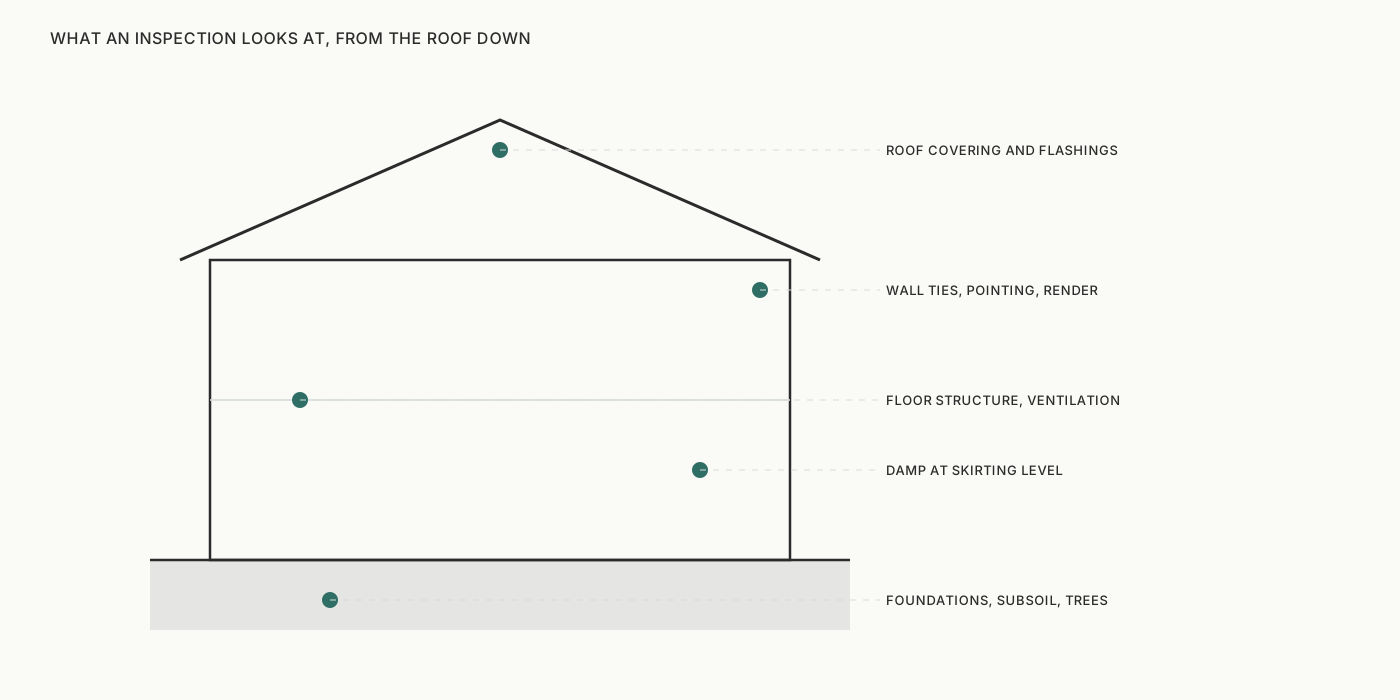
The first thing worth separating is purpose. A mortgage valuation exists to tell a lender whether the property provides adequate security for the sum advanced. It is brief, it is often carried out without entering every room, and in some cases it is done without a visit at all. It is commissioned by the lender, addressed to the lender, and it says almost nothing about condition. Buyers regularly assume it has told them the house is sound. It has not.
A survey or home inspection is commissioned by and addressed to the buyer, and its purpose is to describe the condition of the building: what is worn, what is failing, what has been done badly and what needs investigation by a specialist.
Levels of inspection
British practice recognises roughly three levels. The most basic is a condition report: a visual survey using a simple traffic-light rating, suitable for a conventional modern house in evident good order, with little narrative. The middle level, commonly called a homebuyer report, adds commentary and advice on defects and is the usual choice for a conventional property of moderate age. The most thorough is a building or structural survey, which examines construction in detail, opens up where it is reasonable to do so, and produces a long report; it suits older, altered, unusual or visibly troubled buildings.
American practice is less stratified: a general home inspection covers structure, roof, exterior, plumbing, electrical, heating, cooling and insulation to a published standard, with specialist inspections added where the general inspection recommends them. In both systems the same principle holds: the inspection is non-invasive by default, and the phrase further investigation recommended is not padding. It marks the boundary of what could be seen.
Movement
Cracking is the finding that alarms people most and is the least well understood. Almost every building of any age has cracks, because materials shrink, settle and respond to seasonal moisture. What a surveyor is reading is the pattern rather than the presence: width, direction, whether the crack is tapered, whether it passes through masonry units or follows the joints, whether it appears on both faces of a wall, and whether it is recent or has been filled and reopened.
Subsidence proper means downward movement of the ground beneath the foundations. Its common causes are clay soils shrinking in dry conditions, often influenced by nearby trees drawing water; leaking drains washing out fine material; and historic made ground or mine workings. It is distinguishable from settlement, which is the normal initial compression under a new structure and stops, and from heave, which is upward movement, frequently after a large tree is removed and the soil rehydrates.
The practical significance of movement is often less about structural danger than about insurance and saleability. A property with a history of movement, even one properly underpinned and stabilised, carries a documentation trail that follows it through every subsequent transaction.
Damp
Damp is a category, not a diagnosis, and the three types have entirely different causes.
Penetrating damp comes through the fabric from outside: failed pointing, cracked render, a blocked or overflowing gutter, a defective roof detail, ground raised above the damp-proof course. It is usually localised and it usually corresponds to a visible external defect directly above or beside it.
Rising damp is moisture drawn up from the ground through porous masonry where there is no effective barrier. It shows as a tide mark at low level with salt deposits. It is genuinely rarer than the volume of remedial treatment sold against it would suggest, and a high meter reading alone does not establish it.
Condensation is water already inside the building meeting a cold surface. It appears in corners, behind furniture on external walls and around window reveals, and it is a function of moisture production, ventilation and insulation rather than of any defect in the wall. It has become more common as buildings have been sealed more tightly without ventilation being addressed in the same operation.
Roofs, timber and services
Roof coverings have finite lives that vary by material, and the components that fail first are usually the details rather than the field: flashings at abutments, valleys, ridge bedding, and the fixings of individual units. Inside, the roof structure is read for deflection, for the presence and condition of any strengthening, and for the effects of altered or removed members during a conversion.
Timber decay divides into wet rot, which requires a persistent water source and stops when the source is removed, and dry rot, which can spread through masonry and behind finishes and is treated far more seriously. Beetle infestation is generally historic rather than active, and a survey will say which it believes it is seeing.
Services are the area where inspection is most limited. Electrical installations, gas appliances and drainage are each assessed superficially and referred onward for testing. Drainage in particular is invisible without a camera survey, and defective drainage is one of the recognised contributors to movement, so the two findings often travel together.
Reading the report
A useful report is not the one with the fewest findings. It is the one that separates what is urgent from what is ordinary maintenance, indicates the scale of each item, and is clear about what was and was not accessible. Fitted carpets, full lofts, boarded floors and stored possessions all restrict what can be seen, and a competent report says so explicitly rather than quietly.
Findings are then either priced and factored into the negotiation, or investigated further, or accepted. All three are legitimate responses. What is not useful is treating the presence of findings as itself a verdict on the building, because a house without findings is generally a house that was not examined closely.