Chapter 02
What moves house prices
Borrowing costs and credit conditions move prices quickly. Incomes and supply move them slowly. Expectations move them unpredictably, and only for a while.
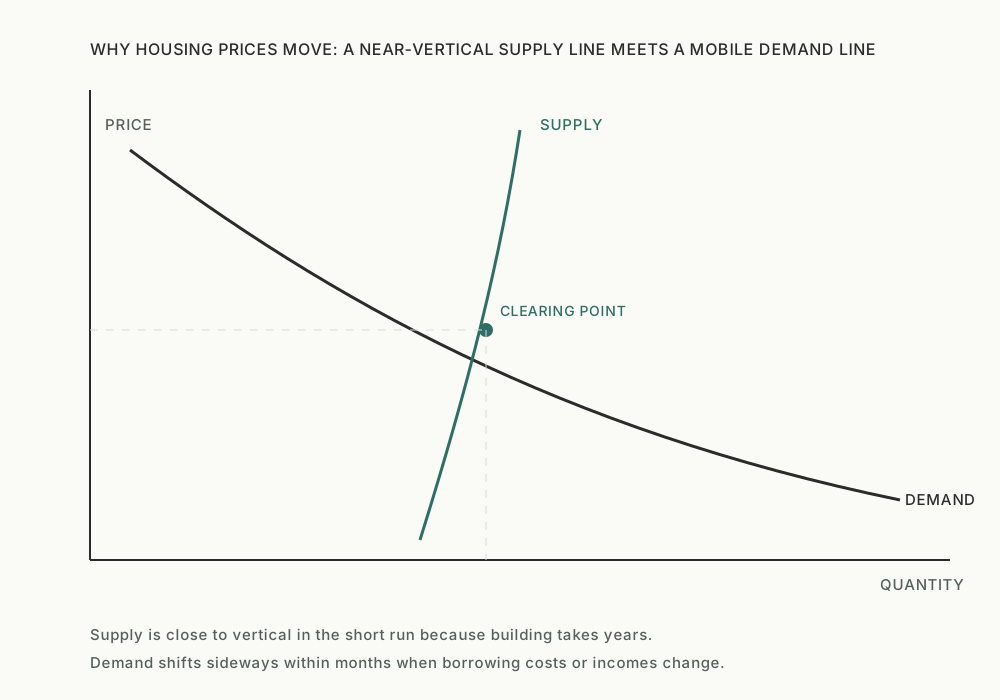
Most explanations of house prices fail because they treat every influence as though it acted on the same timescale. It is more useful to sort the influences by how quickly they show up. Some work within a quarter. Some take a decade. Confusing the two produces the familiar argument in which one side blames borrowing costs and the other blames planning, while both are describing real forces operating at different speeds.
The fast movers
The cost of borrowing. For the large majority of buyers who borrow, the binding constraint is a monthly payment, not a purchase price. When the cost of borrowing falls, the same monthly payment supports a larger loan, and the amount that buyers can bid rises without anyone earning any more. When it rises, the reverse happens with equal arithmetic force. This is the single most powerful short-run influence on prices, and it acts within months.
Credit availability. Distinct from the cost of credit is the question of whether it is offered at all: the deposit expected, the income multiple permitted, the stringency of affordability testing, the treatment of variable or self-employed income. Loosening these can raise prices even while rates are flat, because it enlarges the pool of people able to bid. Tightening them can cut prices even while rates fall, because it removes bidders entirely rather than merely reducing what they can offer. Deposit requirements bite hardest on first-time buyers, who are the entry point of the whole chain.
Transaction taxes and incentives. Changes to transfer duties and to schemes aimed at particular buyer groups tend to move activity in time rather than change its total. A deadline pulls transactions forward into the weeks before it and leaves a hole after it, and both the surge and the hole get reported as changes in the underlying market when they are mostly changes in timing.
The slow movers
Incomes. In the long run, what people can pay for housing is bounded by what they earn, and the ratio of local prices to local earnings is the most durable measure of whether an area is expensive. But incomes change by a few percentage points a year, so they explain the decade rather than the quarter. Where the ratio has moved a long way, the explanation is almost always credit conditions rather than a change in what people earn.
The stock itself. Net additions to housing stock in an established area are usually a fraction of one per cent a year, and some of that is offset by demolition, conversion and change of use. Building more affects prices, but through a mechanism that is slow and cumulative rather than immediate. Its most visible short-run effect is local and compositional: a large new development changes what is available in one place, and changes the reference points that buyers use there.
Constraint on where building can happen. Where land use is tightly controlled, the supply response to higher prices is weak, so demand pressure resolves almost entirely into price. Where it is loose, the same pressure resolves partly into new dwellings. This is why two regions with similar income growth can show completely different price paths. It is a structural parameter, not a monthly one.
Household formation. The number of dwellings needed depends less on population than on how population sorts itself into households. Later partnership, longer lifespans, more single-person households and more people living alone after separation all raise the number of dwellings a stable population requires. Conversely, when housing costs rise, household formation slows: adults stay in a family home or share for longer, which suppresses measured demand and disguises the pressure.
Location, and what it is actually pricing
Location premiums are usually a bundle of measurable things wearing one word. The largest components are typically access, meaning journey time to concentrations of employment, and the quality and admission rules of nearby schools. Both are capitalised into prices with considerable precision, and both can produce sharp discontinuities: two otherwise identical houses on opposite sides of a catchment boundary or a transport walkshed will not trade at the same figure.
Other components are quieter but real. Aspect and light. Noise from roads and flight paths. Flood exposure, and increasingly the insurability that follows from it. Parking, in places where it is scarce. The presence or absence of through traffic on the street itself. None of these is mysterious; all of them are frequently ignored by summary statistics that compare properties only by size and type.
Expectations, and their limits
Because a house is both a place to live and the largest asset most households will own, expectations feed back into prices. If buyers believe prices will rise, buying sooner looks cheaper than buying later, which raises current demand. If they believe prices will fall, waiting looks free, and demand thins. This feedback is genuine and can run for a considerable time.
It is also bounded. Expectations cannot indefinitely override the payment arithmetic, because at some point the monthly cost exceeds what lenders will underwrite. What usually ends a self-reinforcing run is not a change of sentiment but a change in credit: the loan that would have been made last year is not made this year, and the marginal bidder disappears.
Three different numbers
Finally, it is worth being careful about which price is under discussion, because three quite different figures circulate under the same name.
The asking price is a marketing position. It is set before any bidder has responded and is revised in the light of response. The agreed price is what a buyer and seller settled on, which may still change after inspection or valuation. The recorded price is what appears in public records after completion, typically months later, and describes a decision made in different conditions from today's.
An index built on asking prices turns first and overstates. An index built on recorded prices turns last and understates. Neither is wrong; they are answering different questions, and a great deal of confusion comes from comparing one directly with the other.